



How to Choose a Front-Opening Suitcase | Also Explaining Considerations for Carry-on and Shinkansen-Compatible Models
Hello, this is New Trip.
When purchasing a suitcase, have you ever wondered, "Is the front-opening feature really convenient?", "What size works for both Shinkansen and airplanes?", or "Do I need silent casters?"
This article will provide selection criteria based on actual use cases to help you avoid making a mistake when choosing a suitcase. We will focus on problems users actually face, rather than manufacturer advertisements.
1. Advantages and Realistic Disadvantages of Front-Opening Suitcases
What is a Front-Opening Feature?
A front-opening type features an additional pocket on the front of the suitcase, allowing you to access contents without fully opening the main compartment.
Actual Advantages:
- You can retrieve a laptop or tickets while the suitcase is upright.
- Less likely to inconvenience others at stations or airports.
- Personal belongings are less visible.
Actual Disadvantages:
- The main storage capacity is slightly reduced due to the front pocket's divider (typically 5-10% less).
- Some products may "bow" forward due to the weight in the front compartment.
- The zipper section tends to be more prone to damage (as two zippers need to be managed).
- Inexpensive products may have a flimsy internal divider structure.
The presence or absence of a front-opening feature should not be the sole determinant of your purchase. Honestly, it's "convenient to have, but not essential."
Checking Points When Choosing a Front-Opening Type
If you decide to choose a front-opening type, check the following points:
- Center of Gravity Design: Check the actual product to see if it tilts forward when items are in the front pocket.
- Zipper Quality: Ensure reputable manufacturers like YKK are used.
- Internal Divider: Check if it significantly impedes the main storage or if the actual capacity is specified.
- PC Storage: Check if cushioning material is used and what screen size it accommodates.
2. Airline Baggage Rules: Check the Rules of the Airline You Will Use
The most important factor when choosing a suitcase is to check the baggage regulations of the airline and route you plan to use in advance.
Carry-on Size Differences Based on Seat Count
On Japanese domestic flights, carry-on size varies depending on the number of seats.
| Aircraft Seat Count | Total Dimensions (L+W+H) | Max Size (Approx.) | Weight Limit |
|---|---|---|---|
| 100 seats or more | Within 115cm | 55cm × 40cm × 25cm | Usually no weight limit |
| Less than 100 seats | Within 100cm | 45cm × 35cm × 20cm | Usually no weight limit |
Note: Smaller aircraft with fewer than 100 seats may be used on regional or island routes. Even for flights between Tokyo and regional airports, aircraft with fewer than 100 seats might be used, so it's recommended to check the aircraft type on your airline's website in advance.
Strict Regulations of LCCs (Low-Cost Carriers)
When using LCCs, baggage restrictions become even stricter.
| Airline | Total Dimensions (L+W+H) | Max Size (Approx.) | Weight Limit |
|---|---|---|---|
| Peach Aviation | Within 115cm | 50cm × 40cm × 25cm | Within 7.0kg (strictly measured) |
| Jetstar Japan | Within 115cm | 56cm × 36cm × 23cm | Within 7.0kg (strictly measured) |
| Spring Airlines Japan | Within 115cm | 55cm × 40cm × 25cm | Within 7.0kg |
With LCCs, weight measurements at the boarding gate are very strict. Even exceeding the 7.0kg limit by 0.1kg can result in additional charges.
Strategy for LCC Use: Suitcase "Lightness" is Key
When carrying on luggage with an LCC, the weight of the suitcase itself is important.
For example:
- Suitcase itself is 4.0kg → luggage can only be 3.0kg (impractical)
- Suitcase itself is 3.0kg → luggage can be up to 4.0kg (possible for a 1-2 day trip)
- Suitcase itself is 2.5kg → luggage can be up to 4.5kg (more practical)
If you frequently use LCCs, it's practical to choose a lightweight model with a suitcase self-weight of 3.0kg or less.
3. Shinkansen Suitcase Carry-on Rules
What is the "160cm Rule"?
On the Tokaido, Sanyo, Kyushu, and Nishi-Kyushu Shinkansen lines operated by JR Central, JR West, and JR Kyushu, a pre-booking rule for "oversized baggage seats" has been introduced.
Rule: For baggage exceeding 160cm in total dimensions (L+W+H), you must reserve an "oversized baggage seat" in advance.
If carried on without advance reservation:
- A 1,000 yen (tax included) fee will be collected on board.
- Baggage will be moved to a location designated by the conductor.
Note: As of 2026, the Tohoku, Akita, Yamagata, Joetsu, and Hokuriku Shinkansen lines operated by JR East do not have such mandatory advance reservation rules.
Actual Suitcase Sizes and the "160cm Rule"
The relationship between common suitcase sizes and the 160cm rule:
| Suitcase Size | Total Dimensions (L+W+H) (Approx.) | Shinkansen Reservation | Capacity (Approx.) |
|---|---|---|---|
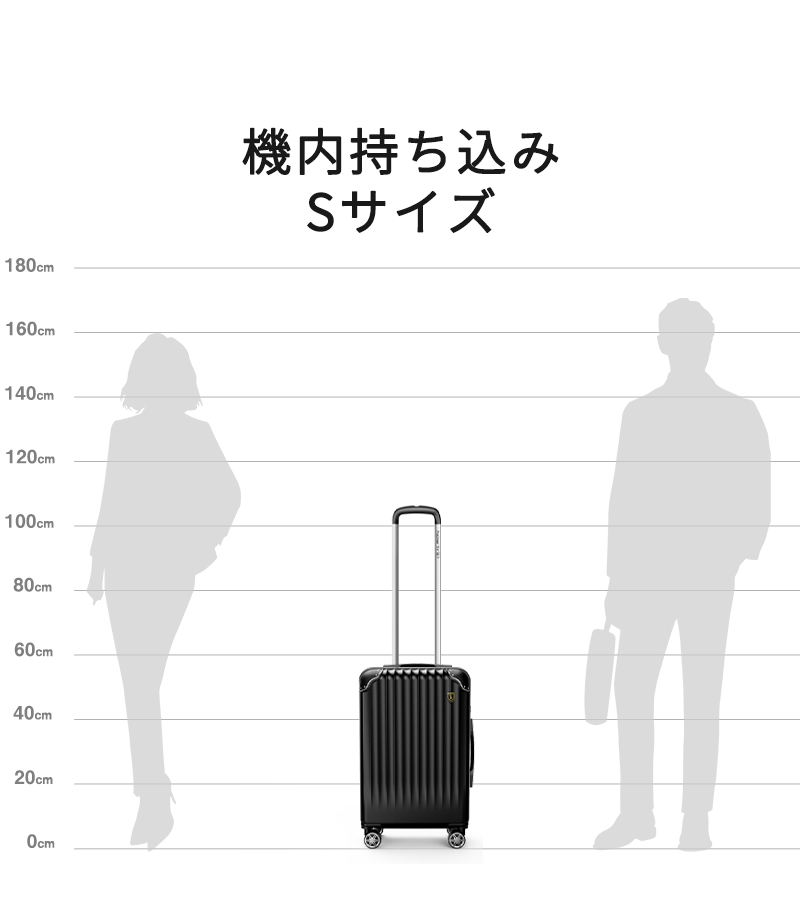
| S size | ~115cm | No reservation required | 35~45L |
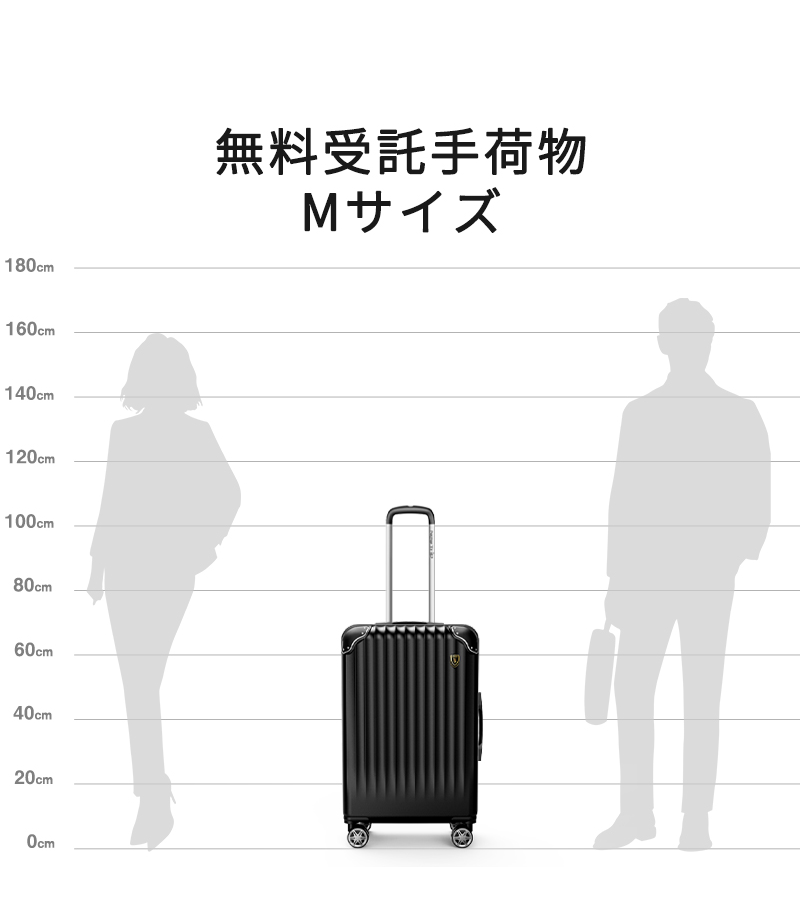
| M size | 115~140cm | No reservation required | 50~65L |
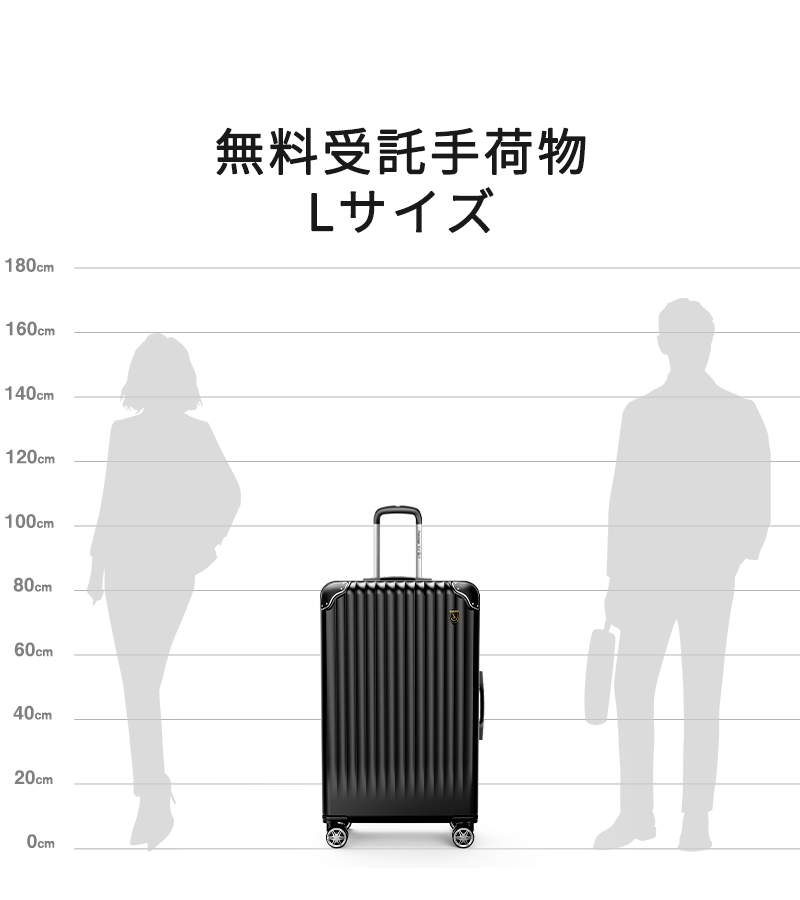
| L size | 140~160cm | No reservation required | 70~85L |
| Oversized | Over 160cm, up to 250cm | Advance reservation required | 100L or more |
Most suitcases fall within the "no reservation required" range. Cases where additional fees are incurred when using the Shinkansen are very limited.
4. Choosing Suitcase Material: Polycarbonate vs. ABS Resin
Characteristics of Main Materials
| Material | Impact Resistance | Lightness | Price Range | Estimated Durability (Years) |
|---|---|---|---|---|
| Polycarbonate (PC) | ◎ High | ◎ Light | Medium~High | 5~7 years |
| ABS Resin | △ Medium | △ Slightly heavy | Low~Medium | 3~4 years |
| Polypropylene (PP) | △ Low | ◎ Light | Low | 2~3 years |
Characteristics of Polycarbonate: A material used in bulletproof shields and aircraft windows. It is lightweight, highly impact-resistant, and offers excellent long-term durability.
Characteristics of ABS Resin: Easy to process and available in a wide variety of colors and designs. While less durable than polycarbonate, its lower price makes it suitable for short-term use.
Characteristics of Polypropylene (PP): The lightest, making it advantageous for LCC use. However, its low impact resistance means a higher risk of damage.
Criteria for Material Selection
- Frequent LCC use: Prioritize lightness (polypropylene or lightweight polycarbonate)
- Want to use for a long time: Prioritize durability (polycarbonate)
- Budget-conscious: ABS resin is also an option
- Frequent business trips or domestic travel: Prioritize balance (polycarbonate recommended)
5. Choosing Casters (Wheels) and Capacity Expansion Features
Double Casters vs. Single Casters
Suitcase casters come in two types: "single casters" with one wheel per axle, and "double casters" with two wheels per axle.
- Double casters: Highly stable, smooth turning. Generally considered "standard."
- Single casters: Lighter, but less stable and tend to be noisier.
When choosing a suitcase, double-caster models are generally the default.
The Actual Meaning of "Silent"
Suitcase manufacturers often tout "silent casters," but the actual quietness depends on several factors:
- Caster rubber material: Urethane rubber is common. Higher quality leads to less noise.
- Floor surface condition: The sound will differ on new asphalt versus old asphalt.
- Amount of luggage: Heavier luggage can sometimes make more noise than lighter luggage.
The term "silent" is relative. If you plan to use it in a quiet residential area late at night, it's recommended to try it out before purchasing.
Advantages and Disadvantages of Capacity Expansion Feature (Expandable)
The expansion feature allows you to increase the depth of the suitcase by approximately 5cm by unzipping a side zipper.
Advantages:
- You can depart with a carry-on size and expand the capacity for souvenirs on the way back.
- No need to buy an additional suitcase.
Disadvantages/Considerations:
- When expanded, it may no longer be eligible as a carry-on item. For example, it might exceed the 115cm total dimension limit.
- A smart way to use it is to board with the carry-on size (without expansion) on the outbound journey, and then, on the return journey, open the expansion zipper at your destination and check it in as checked baggage at the airline counter.
The expansion feature is "convenient," but not essential. Choose it based on your travel style.
6. Points to Actually Check When Choosing a Suitcase
Items to Check Before Purchase
| Checking Item | Checkpoints | Importance |
|---|---|---|
| Size (Total 3 dimensions) | Does it meet the regulations of the airline or Shinkansen you will use? | ★★★ |
| Weight (Self-weight) | If planning to use LCCs, aim for 3kg or less | ★★★ |
| Material | Polycarbonate recommended. ABS resin for short-term use | ★★★ |
| Casters | Double casters. Roll it around to check for any discomfort | ★★ |
| Handle | Can the height be adjusted in multiple stages? Is it wobbly? | ★★ |
| Zippers | Are they from a reliable manufacturer like YKK? Do they open and close smoothly? | ★★ |
| Warranty Period | Is there a minimum 1-year warranty? Are the coverage details specified? | ★★ |
| Return/Exchange Policy | Is return/exchange possible after arrival? What is the period? | ★ |
Checking Points for Online Purchase
When purchasing online, check the following points:
- Does the manufacturer provide detailed exterior dimensions?
- Are there user reviews mentioning the "size and feel"?
- Is the return policy robust (at least 10 days desired)?
- Are customer support contact details clearly stated?
7. Frequently Asked Questions (FAQ)
Check the aircraft type and carry-on size regulations on the official website of your airline in advance. For aircraft with fewer than 100 seats, the general rule is within 100cm total dimensions (within 45cm × 35cm × 20cm). Even S-size suitcases can sometimes exceed these regulations, so it's important to accurately check the manufacturer's exterior dimensions. If you are unsure, it is recommended to contact the airline directly.
For a 1-2 day trip, if the suitcase itself is under 3.0kg, you can pack up to 4.0kg of luggage. In reality, clothing alone often weighs 2-3kg, and electronic devices like laptops can add 1-2kg, so aiming for a suitcase that is "2.5kg or less" is a safer bet.
It's not essential. While convenient, the front pocket's divider slightly reduces the main capacity. Consider the trade-off between convenience at stations and airports and capacity. Standard two-way opening types are also quite practical.
Yes, when expanded, the total dimensions increase, potentially exceeding the original carry-on regulations. If you plan to use the expansion feature, plan to check it in as checked baggage at the airline counter on your return journey.
If it's an S-size (total 3 dimensions 115cm or less), you can place it on the overhead luggage rack. For M-size (total 3 dimensions 140cm or less), you can place it at your feet or secure foot space by using a reserved seat. Even for L-size (total 3 dimensions 140-160cm), no reservation is required, but since it needs to be placed at your feet, we recommend using a reserved seat.
If you intend to use it for a long period (3 years or more), we recommend polycarbonate for its superior impact resistance. For short-term use (1-2 years), ABS resin is fine. However, if you frequently use LCCs, prioritizing lightness and choosing a lightweight polycarbonate model is more practical.
Suitcases can sometimes be damaged during airline ground handling. However, airline policies often state that damage from normal wear and tear is not covered. If you discover damage, report it to the airline immediately and request assistance.
A TSA lock is a locking mechanism that can be opened by Transportation Security Administration (TSA) agents in the United States using a special tool. Many models include them for international flights. If you only fly domestically, the presence or absence of a TSA lock is not a selection factor.
8. How to Choose a Front-Opening Model: New Trip 0501 S Size
Front-opening suitcases that meet all the conditions described so far are actually limited. Among them, the New Trip 0501 S size is a model that genuinely combines "front-opening x Shinkansen compatible x carry-on compatible x expansion feature."
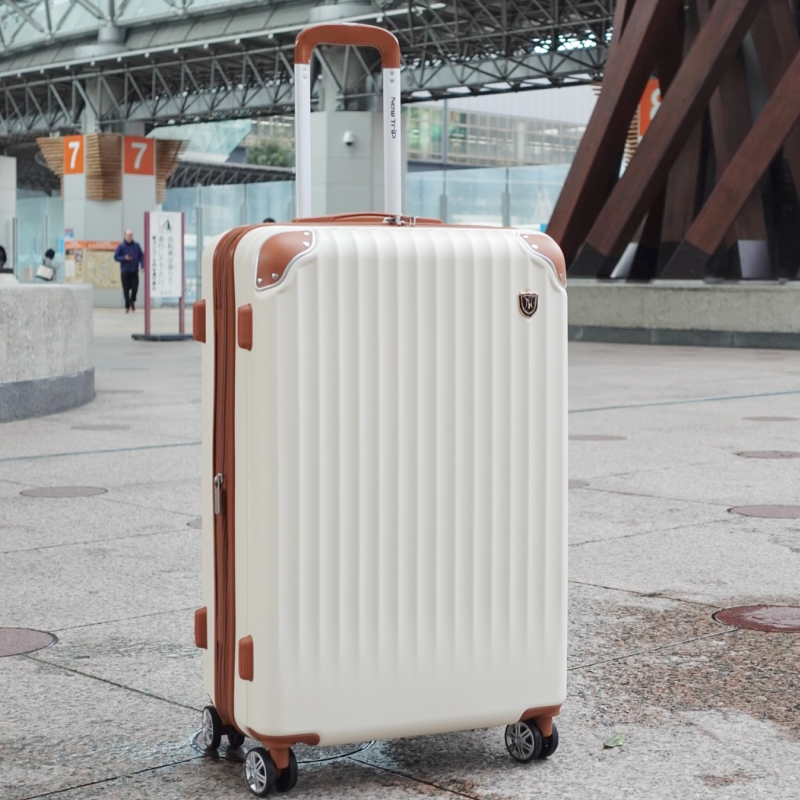
New Trip 0501 S Size
Equipped with a horizontally opening front compartment that allows easy access while standing. The suitcase itself is lightweight yet boasts high durability thanks to its polycarbonate material.
Main Specifications:
- Exterior dimensions: Approx. 54 × 37.5 × 23cm (Total 3 dimensions approx. 114.5cm)
- Capacity: Approx. 40L (49L when expanded)
- Self-weight: Approx. 3.43kg
- Material: Polycarbonate
- Front-opening: 180-degree opening, compatible with PCs (up to 15.6 inches)
- Key features: Double casters, expansion function, USB port, TSA lock, 1-year warranty
Compatibility:
- ✅ Shinkansen (160cm rule): Fully compatible (no reservation required)
- ✅ Airplanes with 100+ seats: Compatible if total dimensions (H+W+D) are within 115cm
- ✅ LCCs: Own weight 3.43kg, so compatible within 7kg for about 1-2 nights' luggage
- ✅ Small aircraft with <100 seats: Total dimensions (H+W+D) are 114.5cm, so highly likely to be compatible, but requires confirmation with the airline
Note for purchase: External dimensions are as stated by the manufacturer, so please be sure to confirm with the airline. Especially for aircraft with fewer than 100 seats, regulations may vary depending on the aircraft type and airline.
Comparison with Other Front-Opening Models
While many suitcases with front-opening functions are available on the market, models that simultaneously meet "Shinkansen compatibility," "carry-on compatibility," and "lightweight" are limited. It is important to select based on the following points:
- Center of Gravity Design: Ensure the main body does not tip forward even when luggage is placed in the front pocket.
- Zipper Quality: Is it from a reliable manufacturer such as YKK?
- Presence of Expansion Function: Useful for increasing capacity on the return journey.
- Warranty Period: Is there a minimum 1-year warranty?
9. Suitcase Selection Summary: What Functions Do You Need?
To avoid failure in choosing a suitcase, let's summarize at the end.
Selection Guide by Usage
[If you frequently use LCCs]
- Highest priority: Lightness of the suitcase itself (target 2.5kg or less)
- Second priority: Check if the size is within regulations
- Options: Polypropylene or lightweight polycarbonate
[If you mainly use the Shinkansen]
- Highest priority: Check if total dimensions (H+W+D) are 160cm or less
- Second priority: Check if it can be placed on the luggage rack above the seat
- Options: S to M size, polycarbonate material
[Mainly domestic flights with 100+ seats]
- Highest priority: Total dimensions (H+W+D) within 115cm
- Second priority: Durability (polycarbonate recommended)
- Options: S size, models with a warranty of 1 year or more
[If you want a front-opening function]
- Highest priority: Physically confirm the center of gravity design is stable
- Second priority: Zipper quality and PC storage specifications
- Options: Proven models such as New Trip 0501
Final Checklist
- ☐ Confirmed carry-on regulations of the airline to be used
- ☐ If using the Shinkansen, confirmed the 160cm rule
- ☐ Confirmed that the manufacturer's stated external dimensions of the suitcase are within regulations
- ☐ If planning to use an LCC, confirmed the weight of the suitcase itself
- ☐ Confirmed the material is polycarbonate or lightweight ABS resin
- ☐ Confirmed it has double casters
- ☐ Confirmed the return/exchange policy
- ☐ Confirmed the warranty period is 1 year or more
- ☐ If it's a front-opening type, confirmed the center of gravity design
10. Finally
Choosing a suitcase begins with understanding your travel style. It's important to thoroughly check the regulations of airlines and railway companies, and clarify what you prioritize (lightness, durability, convenience, etc.).
Instead of deciding solely based on manufacturer advertisements, selecting based on practical points (size, weight, material, warranty) can lead to a comfortable and economical trip.
While the front-opening function is convenient, it shouldn't be the sole criterion for selection. We recommend considering it as an additional useful feature, after fulfilling the basic requirements of "regulation compatibility," "durability," and "lightness."
We hope your future travels will be more enjoyable with your new suitcase.


Leave a comment
This site is protected by hCaptcha and the hCaptcha Privacy Policy and Terms of Service apply.